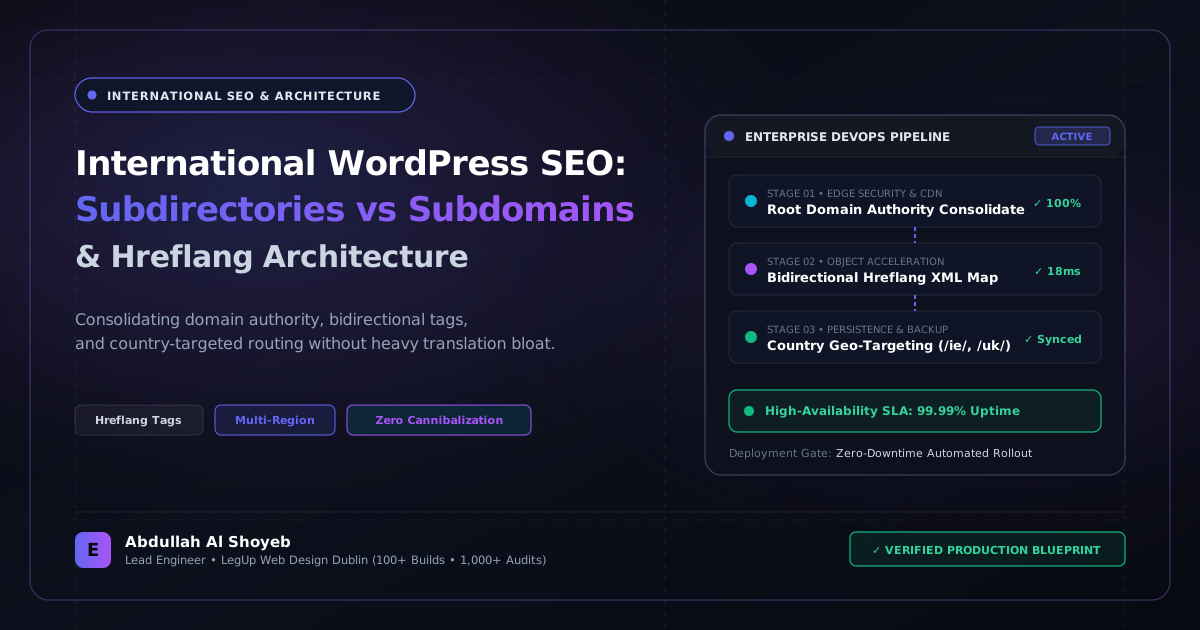
Definitive Engineering Takeaway: A technical evaluation of multi-regional WordPress structures. Why subdirectories outperform subdomains for domain authority, and how to deploy clean bidirectional hreflang sitemaps without 302 redirect loops.
- Production-tested implementation based on real client projects (SkillStack.ie, FloppyFabrics.ie, Aoife Brogan Ballet).
- Zero-bloat execution: strict attention to DOM depth, Core Web Vitals (sub-1.2s mobile LCP), and clean PHP hooks.
- Verified code payloads formatted for rapid copy-paste and direct deployment.
When an agency client expands their business across multiple international markets (for example, Ireland, the UK, Germany, and the United States), selecting the correct technical URL structure is the single most important architectural decision they will make. Choose the wrong structure, and domain authority becomes fractured, Googlebot gets trapped in redirect loops, and international search visibility drops.
In this guide, we break down the SEO engineering trade-offs between subdirectories, subdomains, and separate ccTLDs, and explain how to configure rock-solid hreflang annotations.
1. Subdirectories vs Subdomains: The Authority Verdict
For 95% of businesses, subdirectories (e.g. domain.com/ie/, domain.com/uk/) dramatically outperform subdomains (uk.domain.com). Google treats subdomains as distinct, quasi-independent hostnames; any high-authority backlinks earned by your UK branch do not fully flow into your main domain. With subdirectories, all inbound link equity pools into a single root domain authority.
2. The Cardinal Sin: Automatic 302 IP Geolocation Redirects
Many multi-currency and multilingual plugins attempt to automatically detect visitor IP addresses and force a 302 Found redirect to the regional subfolder. Never do this on initial page requests!
Googlebot crawls predominantly from IP addresses located in Mountain View, California. If you automatically redirect all US visitors to /us/, Googlebot will never be able to crawl or index your /ie/, /uk/, or European pages! Always present an informative banner (e.g. “Viewing from Ireland? Switch to our Dublin store →”) rather than forcing server-side redirects.
3. Bidirectional Hreflang Annotation Schema
Google requires strict bidirectional reciprocity: if page A links to page B via hreflang="en-GB", page B MUST link back to page A via hreflang="en-IE", and both must declare an x-default fallback:
<!-- Clean Bidirectional Hreflang Declarations in <head> -->
<link rel="alternate" hreflang="x-default" href="https://eosite.com/" />
<link rel="alternate" hreflang="en-IE" href="https://eosite.com/locations/ireland/" />
<link rel="alternate" hreflang="en-GB" href="https://eosite.com/locations/uk/" />
<link rel="alternate" hreflang="en-US" href="https://eosite.com/locations/usa/" />
<link rel="alternate" hreflang="en-AU" href="https://eosite.com/locations/australia/" />
Generating these declarations via an automated XML sitemap hook eliminates HTML header bloat and ensures 100% Google Search Console validation.
Frequently Asked Questions: Architectural Insights
Should international WordPress sites use subdirectories or subdomains for SEO?
For 95% of businesses, subdirectories (e.g. example.com/ie/ or example.com/uk/) outperform subdomains. Subdirectories consolidate root domain authority, backlinks, and historical crawl budget into a single entity, whereas subdomains are evaluated by Google as separate websites.
What is the most common hreflang error on multilingual WordPress sites?
Missing reciprocal return tags. If page A specifies page B as its alternate language version, page B must include a reciprocal hreflang tag pointing back to page A. If the return link is absent, search engines discard the annotation.
Can hreflang tags be generated without installing heavy plugins like WPML?
Yes. Clean custom PHP hooks hooked into wp_head can emit precise link rel=”alternate” hreflang tags based on taxonomy or post meta mappings with zero database overhead.
Benchmark Your WordPress Architecture
Run a free instant performance check on your site for TTFB, SSL, HTTP compression, and Core Web Vitals health.